Envelope Encryption for Scalable Key Control
Envelope encryption is a design where data is encrypted with one key and that key is then protected with another key used for stronger centralized control.
Envelope encryption is a design where data is encrypted with one key and that key is then protected with another key used for stronger centralized control. In plain language, the system uses a data key for the actual content and a more carefully protected key to wrap or protect that data key.
Why It Matters
Envelope encryption matters because large systems need both performance and control. Encrypting every large dataset directly with a high-assurance central key is often inefficient, but handing raw data keys around carelessly is risky.
It also matters because this pattern makes rotation, access control, and centralized auditing easier in many cloud and platform environments.
Where It Appears in Real Systems or Security Workflow
Envelope encryption appears in cloud storage services, database protection, backup systems, Key Management Service designs, and Hardware Security Module-backed architectures. Teams connect it to Symmetric Encryption, Key Rotation, and Secrets Manager.
It is one of the most common patterns behind practical large-scale encryption systems.
How Envelope Encryption Usually Works
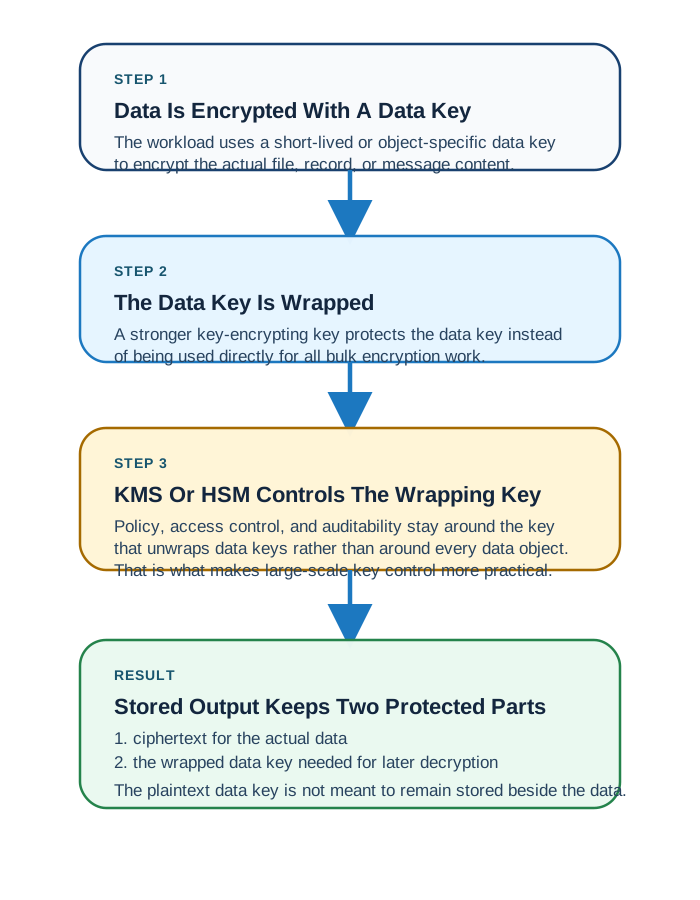
Key Roles In Envelope Encryption
| Part | Main job | Why it matters |
|---|---|---|
| Data key | Encrypts the actual file, record, or object | Keeps bulk encryption efficient |
| Key-encrypting key | Wraps and protects the data key | Lets teams centralize stronger control over key access |
| KMS or HSM-backed control plane | Decides when wrapping or unwrapping is allowed | Improves policy enforcement, auditing, and key custody |
| Stored ciphertext plus wrapped key | Holds the encrypted content and the protected data key together | The application can recover data later without storing plaintext keys alongside it |
Practical Example
A cloud service encrypts a file with a short-lived data key, then stores only the encrypted form of that data key after it has been wrapped by a centrally managed key in a key management service.
That design allows the service to encrypt large amounts of content efficiently while keeping the higher-value control key inside a stricter environment. If the organization later rotates the wrapping key, it can update key protection workflows without necessarily re-encrypting every data object from scratch in the same way.
Common Misunderstandings and Close Contrasts
Envelope encryption is not a different kind of Encryption algorithm. It is an architecture pattern for how keys are used and protected together.
It is also different from simply storing all data under one long-lived key. The point is to separate bulk data encryption from stronger central key control.
It is also not the same as a Secrets Manager. A secrets manager handles operational secret retrieval and storage patterns, while envelope encryption is specifically about how encryption keys are layered and protected.
Related Terms
Knowledge Check
- Why does envelope encryption usually use a separate data key? Because bulk data can be encrypted efficiently while a higher-value wrapping key stays under stricter control.
- What does the wrapping or key-encrypting key protect? It protects the data key rather than directly encrypting every large piece of content itself.
- Why is envelope encryption common in cloud platforms? Because it combines scalable data encryption with centralized key control, auditing, and rotation workflows.