Certificate Transparency for Trust Visibility
Certificate Transparency is a public certificate-logging approach that makes certificate issuance easier to observe and investigate when unexpected trust events occur.
Certificate Transparency is a public certificate-logging approach that helps detect whether certificates have been issued in ways that should be reviewed or questioned. In plain language, it creates a visible record of issued certificates so unexpected issuance is harder to hide.
Why It Matters
Certificate Transparency matters because trust in certificates depends not only on issuance rules but also on visibility. If a certificate is issued unexpectedly for a domain, defenders benefit from being able to detect and investigate that event instead of relying only on the issuing party to notice a problem.
It also matters because public logging improves accountability in the broader certificate ecosystem. The system becomes more observable, which helps reduce the chance that questionable issuance remains unnoticed for long.
Where It Appears in Real Systems or Security Workflow
Certificate Transparency appears in browser trust models, domain monitoring, certificate issuance review, and incident investigation around unexpected certificates. Organizations use it when they want visibility into certificates associated with their domains or services rather than treating issuance as a black box.
It connects closely to Digital Certificate, Certificate Authority, Certificate Revocation, Certificate Pinning, Public Key Infrastructure, and TLS.
It is most useful when organizations actively watch for certificates related to their domains instead of assuming unexpected issuance will be noticed automatically.
How Certificate Transparency Improves Visibility
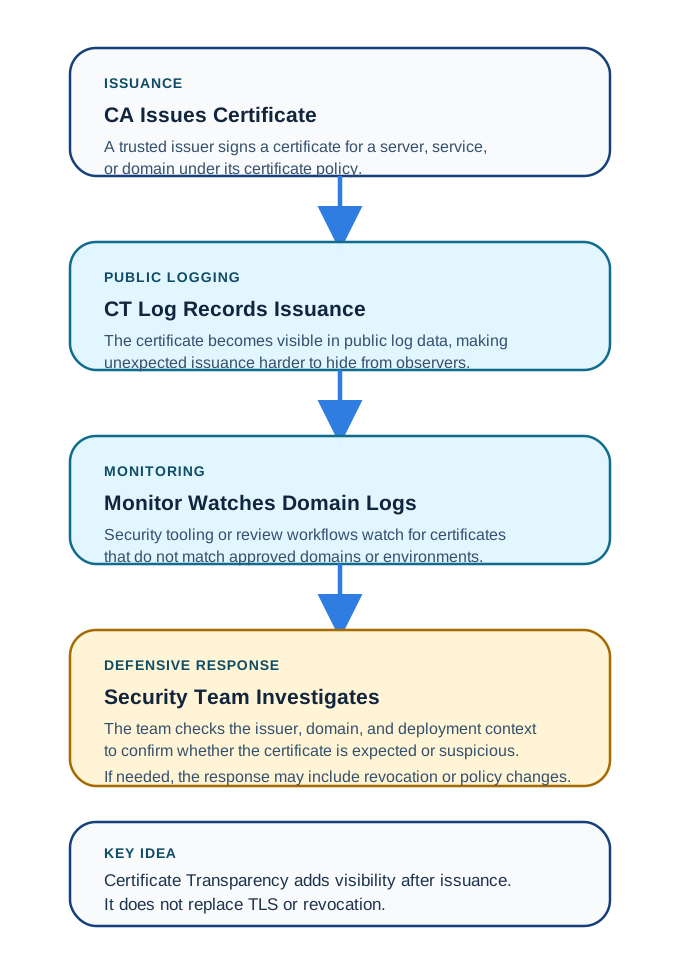
What Certificate Transparency Helps With
| Question | How Certificate Transparency helps | What still has to happen elsewhere |
|---|---|---|
| Was a certificate issued for this domain? | Public logs make the issuance visible to monitors and investigators | Teams still need monitoring or review processes to notice it |
| Did a trusted CA issue something unexpected? | Logs make suspicious issuance harder to hide | The organization still has to investigate whether the issuance was legitimate |
| Should clients stop trusting the certificate? | Certificate Transparency may reveal the problem faster | Revocation, trust-store policy, or other controls decide whether trust is withdrawn |
| Does Certificate Transparency replace transport security? | No. It supports ecosystem visibility around certificate trust | TLS still protects the session itself |
Practical Example
A company monitors Certificate Transparency logs for its domain names. If a certificate appears that the organization did not expect, the security team can investigate whether it was legitimate, mistaken, or part of a larger trust problem involving domain control or certificate issuance.
That investigation may include checking which Certificate Authority issued it, whether the certificate matches an approved environment, and whether any defensive response such as Certificate Revocation is needed.
Common Misunderstandings and Close Contrasts
Certificate Transparency is not the same as Certificate Revocation. Transparency helps reveal issuance activity, while revocation is the process of withdrawing trust from a certificate that should no longer be trusted.
It is also not the same as TLS itself. It supports trust in the certificate ecosystem around TLS rather than replacing secure transport.
It is also not a protective control by itself in the same way as Certificate Pinning. Transparency gives visibility and auditability; other controls still decide how trust is enforced at connection time.
It is also a mistake to assume that logging alone creates safety. If nobody monitors the logs or responds to unexpected issuance, the visibility benefit may never turn into a defensive action.
Related Terms
- Digital Certificate
- Certificate Authority
- Certificate Revocation
- Certificate Pinning
- Public Key Infrastructure
- TLS
Knowledge Check
- What is the main benefit of Certificate Transparency? It makes certificate issuance more visible so unexpected certificates are harder to hide.
- How is it different from certificate revocation? Transparency reveals issuance activity, while revocation removes trust from a certificate.
- Does Certificate Transparency replace TLS? No. It supports trust in the certificate ecosystem around TLS.
- What turns CT visibility into a useful defensive control? Monitoring and investigation processes that actually review unexpected certificate activity.